Low-Head Landscape Dam Selection Guide: A Comprehensive Comparative Analysis of Rubber Dams and Shield Rubber Dams
In the engineering of urban river regulation and water landscape construction, the selection of low-head movable dams is directly linked to the safety, economy, and ecological benefits of projects. This paper focuses on the two most widely applied dam types—rubber dams and air-supported dams—and conducts an in-depth comparison from dimensions including structural principles, performance characteristics, and engineering applications, providing comprehensive technical references for water conservancy engineering practitioners.
The core component of a rubber dam is a composite dam bag formed by vulcanizing a high-strength fiber skeleton layer with a rubber protective layer. The dam bag is fixed to the foundation slab via embedded anchor bolts to form a closed bag, which expands through water or air inflation to achieve water retention. This flexible structure grants it unique adaptability—when encountering uneven foundation settlement, the dam bag maintains overall stability through self-deformation, demonstrating significant advantages in soft soil foundation scenarios.
As an innovative combination of rubber dams and hydraulic gates, the air-supported dam upgrades the water-retaining component from a rubber bag to a steel shield plate, using high-strength airbags as the lifting power device. This modular design allows a single-span gate to be composed of multiple shield plate-airbag units, preserving the flexible seismic characteristics of rubber dams while enhancing scouring and impact resistance through steel plates. Notably, its anchoring structure comes in single-airbag and double-airbag forms, enabling flexible selection based on project needs, with a safety factor of 8-10 times—far exceeding industry standards.
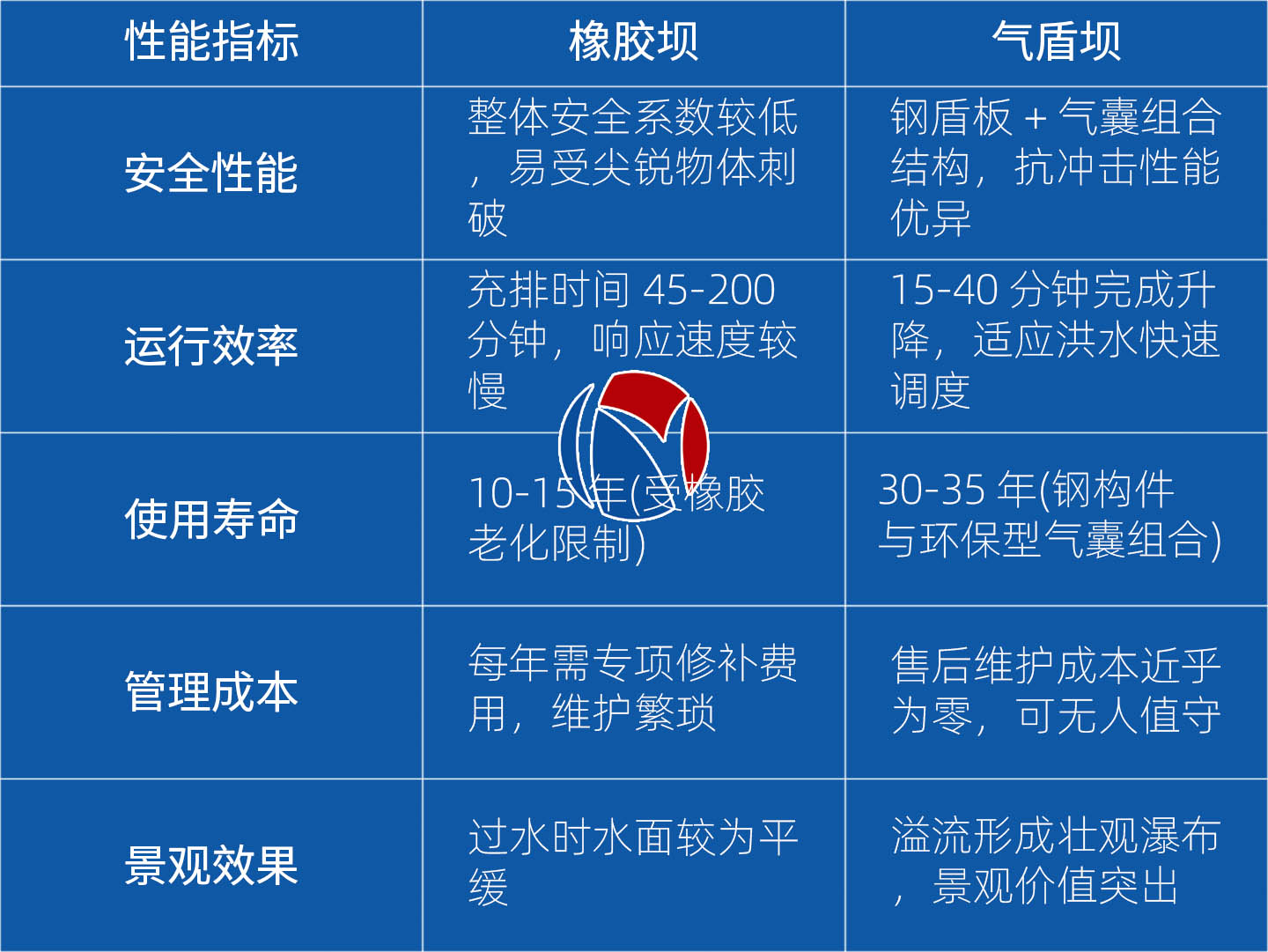
Air-supported dams have surpassed traditional rubber dams in multiple technical indicators:
-
Using air as the filling medium, they completely solve the problem of water freezing in rubber dams during winter, even enabling ice retention in early winter.
-
Equipped with angle sensors and an electric-hydraulic control system, the dam body can automatically adjust according to water levels, showing excellent adaptability in mountainous rivers with sudden flood fluctuations.
-
The application of steel shield plates enhances wear resistance by over 3 times when facing complex river conditions such as rolling stones and sediment.
-
Rubber Dams: More suitable for urban landscape rivers with minimal debris and stable riverbeds. Their flexible single-dam span and simple foundation structure offer initial investment advantages in small and medium watershed management. A case study of an urban landscape belt project shows that the unit length cost of rubber dams is 20%-30% lower than air-supported dams.
-
Air-Supported Dams: Particularly suitable for three types of complex environments:
-
Mountainous rivers with sudden floods (e.g., a governance project on a tributary of the Yellow River, where the air-supported dam completed collapse and flood discharge within 30 minutes)
-
Rivers with high floating debris and sediment content (steel shield plate anti-scouring design avoids dam wear)
-
Remote areas with inconvenient transportation and power supply (automated control systems reduce manual intervention)
From a long-term operation perspective, the comprehensive cost advantages of air-supported dams gradually emerge:
-
Initial Investment: Air-supported dams have higher basic investment, with overall costs 15%-25% higher than rubber dams.
-
Maintenance Costs: Rubber dams incur annual maintenance fees of about 5%-8% of the initial investment, while air-supported dams only require basic inspections after 20 years of operation.
-
Service Life: Calculated over a 30-year cycle, the unit cost of air-supported dams is 40% lower than rubber dams.
Both dam types use eco-friendly materials:
-
The vulcanization process of rubber dam bags achieves zero pollution emission.
-
Air-supported dams use air as the medium, eliminating the risk of hydraulic oil leakage, offering unique advantages in sensitive areas such as drinking water sources. In a drinking water protection zone project, the environmental design of an air-supported dam passed the certification for Class Ⅰ surface water quality standards.
Air-supported dams show significant advantages in automation:
-
Their supporting remote control system can connect to water conservancy information platforms, enabling real-time monitoring of water levels, flow rates, and dam status.
-
In a Yellow River ecological governance project, the air-supported dam system 联动 (interacted) with the basin flood forecasting model, shortening flood warning response time to 15 minutes.
-
Rubber dams typically require underground pump houses, where humid environments easily cause equipment corrosion, leading to high costs for automation upgrades.
-
Safety-Priority Scenarios: Projects with river sediment content >5kg/m³ or flood return periods >50 years should prioritize air-supported dams.
-
Economy-Sensitive Projects: Rubber dams offer cost advantages for temporary landscape projects with a service cycle <15 years.
-
Management Convenience Needs: The automated system of air-supported dams is indispensable for remote or unattended scenarios.
-
Successful Rubber Dam Application: A plain urban landscape belt project with a river width of 40m and annual sediment content <2kg/m³ adopted rubber dams to achieve low-cost landscape construction, with maintenance costs controlled at 12% of the initial investment over 10 years.
-
Air-Supported Dam Advantage Scenario: A mountain river governance project with 32 annual rolling stone impacts saw no damage to the steel shield plate structure of the air-supported dam, while a 同期 (simultaneously) constructed rubber dam required overall replacement in the 3rd year due to bag punctures.
With the rising demands for intelligence and ecologicalization in water conservancy projects, air-supported dams— 作为 (as) innovative products integrating the advantages of steel dams and rubber dams—are demonstrating strong development momentum. Currently, their key components have achieved 100% localization, with performance indicators exceeding imported products while reducing costs by over 30%. Against the backdrop of "Smart Water Conservancy" construction, the unattended and remote control features of air-supported dams will become important development directions for low-head dam types in the future.