

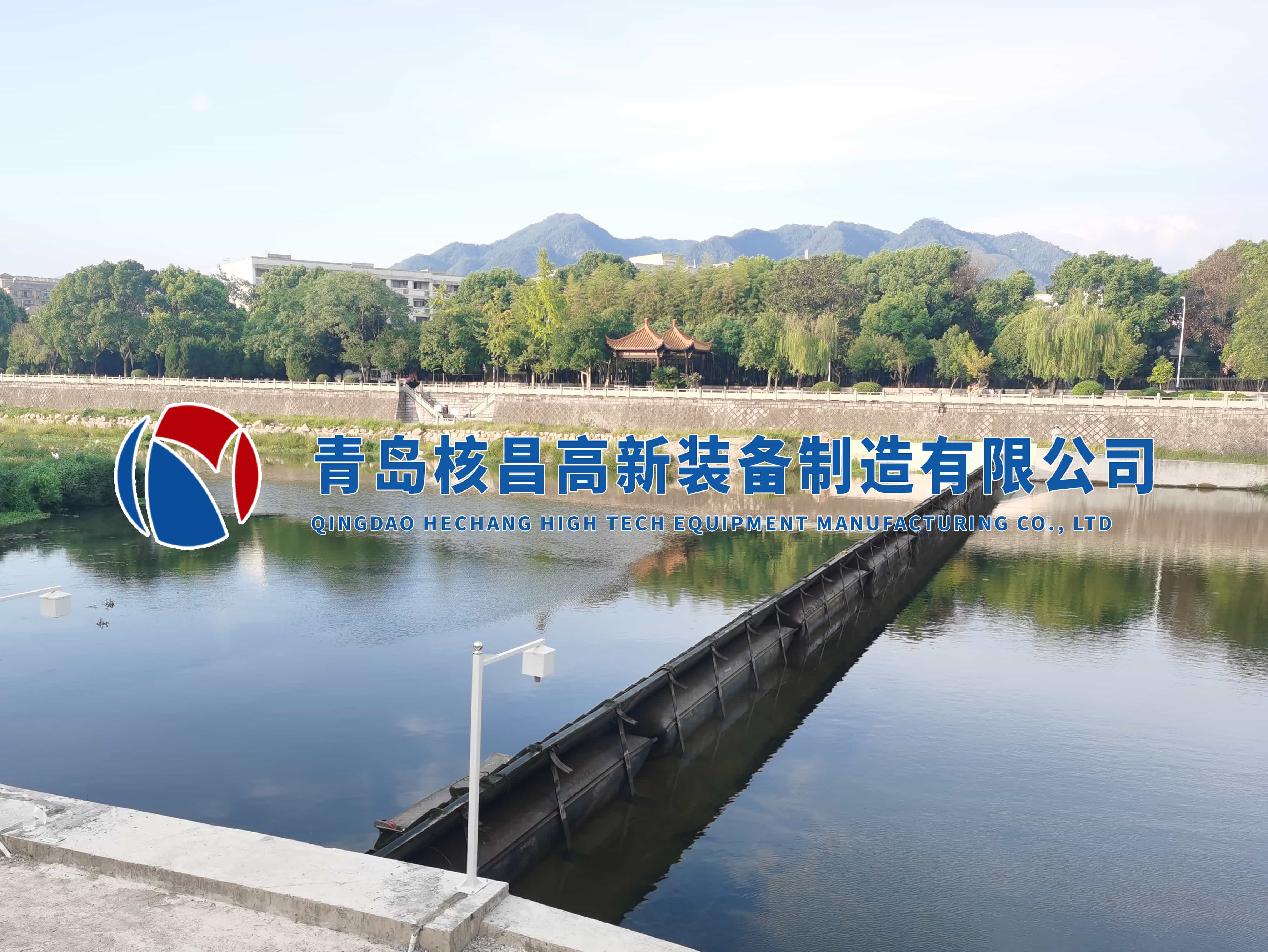
Recently, the "Air Shield Dam Flow Coefficient Calculation System" independently developed by our company has achieved a major breakthrough. Through multi-dimensional technological innovations, this system has effectively improved the accuracy and reliability of flow coefficient prediction for air shield dams, providing strong support for the efficient operation and precise regulation of air shield dam projects. As a new type of hydraulic structure that combines the advantages of rubber dams and steel plate dams, air shield dams feature a simple structure, short construction period, and outstanding flood control and flood passage capabilities. They are widely used in various rivers with complex hydrological conditions and urban landscape rivers. However, traditional flow coefficient calculation methods rely on single-source data, making it difficult to multi-dimensionally handle the impacts caused by changes in the structure of air shield dams, the shape of the dam crest, and incoming flow conditions. To address this, our company has developed the Air Shield Dam Flow Coefficient Calculation System, which integrates three types of data—field measurements, physical model tests, and numerical simulations—through a multi-source data acquisition module. This module covers key information such as air shield dam structural parameters, dam crest shape parameters, and incoming flow condition data, laying a comprehensive data foundation for subsequent analysis. The feature engineering processing module in the system performs feature processing on the preprocessed multi-source data. It obtains an initial training dataset through sampling, then screens out parameter features that significantly affect the flow coefficient based on correlation coefficient analysis, and normalizes continuous features. This greatly improves data quality. In terms of model construction, the system innovatively adopts a hybrid model, including an RF-LSTM layer, a GNN layer, and a fusion layer. The RF-LSTM layer combines the advantages of random forests and long short-term memory networks to process structural parameters, numerical features of the dam crest shape, and incoming flow condition features respectively, outputting the first predicted flow coefficient. The GNN layer, based on graph neural networks, conducts training by constructing relationships between nodes and edges, outputting the second predicted flow coefficient. The fusion layer performs a weighted sum of the two prediction results to obtain the final predicted value, giving full play to the advantages of different models and learning data features from multiple dimensions. The successful development of this system not only improves the accuracy of flow coefficient prediction for air shield dams but also provides a scientific basis for the design, operation, and management of air shield dam projects. It helps to better exert the role of air shield dams in flood control, irrigation, landscape, and other aspects. In the future, we will continue to deepen our efforts in the field of air shield dam technology, continuously promote technological innovation and upgrading, and contribute more to the development of the water conservancy engineering industry.