
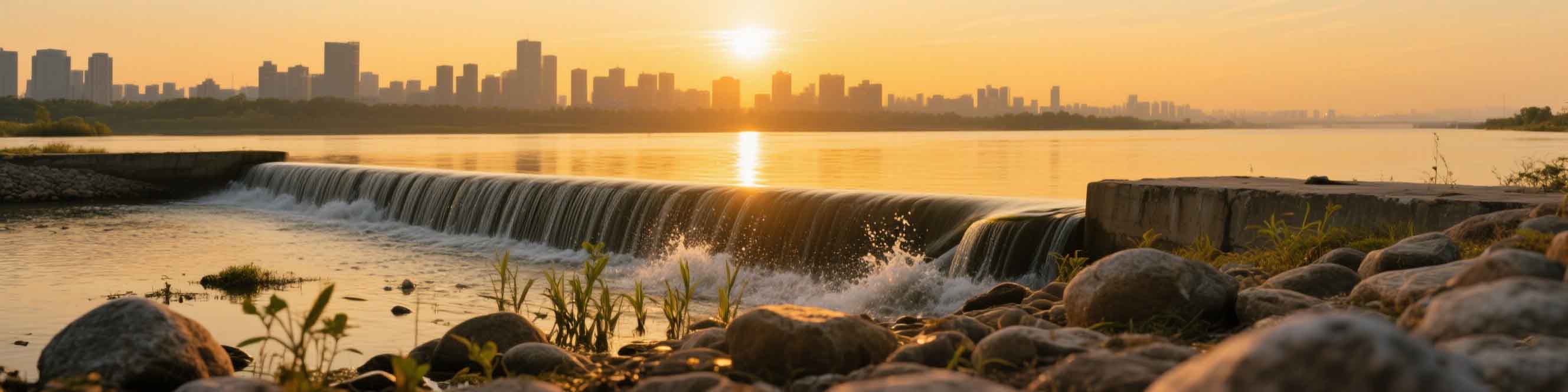
To minimize the impact on the river ecological environment while constructing an air shield dam, it is necessary to implement comprehensive measures from multiple dimensions such as engineering design, construction management, operation regulation, and system coordination. The specific measures are as follows: I. Ecologically Friendly Engineering Design: Minimizing Interference from the Source 1. Collapsible Dam Body and Ecological Airbag Structure
The air shield dam adopts a flexible design of "inflating to retain water and deflating to allow flow". Its shield plates can be completely laid down without altering the natural shape of the river channel. For example, the Xiadang Air Shield Dam in Shouning, Fujian Province can be "laid flat" within 10 minutes during the flood season, restoring the river's flood discharge cross-section and avoiding long-term blockage of fish migration routes. The airbags use air as the medium and do not require hydraulic oil or lubricating oil, thus eliminating pollution risks from the material perspective. 2. Precise Water Level Regulation and Ecological Flow Guarantee
An intelligent control system is used to achieve "millimeter-level" water level regulation, which matches the habits of different fish species. For instance, during the fish migration period, the water level difference between the top of the dam and the downstream can be controlled within a specific range (such as forming a small waterfall or a gentle slope) to guide fish passage. For sensitive fish species, a "step-by-step fish passage" mode can be programmatically set (e.g., lowering the dam by 20 centimeters per hour) to simulate natural water flow changes and improve the success rate of migration. II. Strict Management During the Construction Period: Reducing Temporary Disturbance 1. Pollution Prevention and Ecological Isolation
Construction wastewater must be treated by oil separators and sedimentation tanks before being reused or discharged up to standard, and solid waste is prohibited from entering the water body. Enclosures and dust-proof nets are set up in the construction area to reduce dust and noise pollution. For example, in the Sui-Bian River Water Activation Project in Sihong County, the wastewater from washing construction machinery was reused after treatment in oil separators, and the residual water from sludge was discharged after sedimentation, avoiding damage to the habitats of benthic organisms. 2. Minimizing Construction Land Occupation and Vegetation Restoration
The construction scope is strictly defined to avoid occupying cultivated land and natural vegetation areas. For temporary land occupation, the topsoil must be stripped in advance, and re-greening and reclamation shall be carried out after construction. For example, in the Liujiang River Regulation Project in Guizhou Province, construction access roads were designed to avoid cultivated land as much as possible. The topsoil in the occupied areas was stripped and piled separately, and after the project was completed, the topsoil was used to restore the cultivated land. Meanwhile, turf was planted on the ecological riverbanks for slope protection. III. Dynamic Regulation During the Operation Period: Adapting to Ecological Needs on Demand 1. "Make Way" Mechanism During Migration Periods
During the critical periods of fish reproduction or migration (such as the spring fish spawning season), the dam body is proactively laid down completely to temporarily restore river connectivity and create a "life channel" for fish. Compared with the traditional fishway which is like "building a small path", this mode of "making way for the entire main road" is more friendly to rare fish species with weak swimming abilities, increasing the migration success rate by more than 70%. 2. Pulsed Discharge and In-Situ Dredging
During the non-flood season, leveraging the air shield dam's feature of rapid lifting and lowering, "pulsed discharge" is implemented for dredging: the dam is suddenly lowered to create short-term strong water flow, which scours the sediment and garbage deposited in front of the dam, reducing the disturbance to the river channel caused by manual dredging. For example, a tributary of the Yellow River adopted a "weekly dredging" mode (quickly lowering the dam for 15 minutes every early morning), which effectively controlled sediment deposition and reduced the risk of ecological damage. IV. Systematic Collaborative Governance: Integrating into the Watershed Ecological Network 1. Coordination with Ecological Restoration Measures
The construction of the air shield dam must be advanced in synchronization with water conservation, shoreline restoration, and pollution control. For example, in the urban section of the Weihe River in Xianyang, riparian wetlands and ecological buffer zones were built around the air shield dam. Vegetation was used to purify water quality and provide habitats for aquatic organisms. In the water system connectivity project in Shouning County, the air shield dam was combined with river dredging, bank slope improvement, and pollution prevention and control projects, forming a closed loop of "flood control - water purification - habitat restoration". 2. Intelligent Monitoring and Predictive Scheduling
By integrating data from GIS, real-time hydrology, water quality, and fish activity monitoring, a "smart brain" is established to realize dynamic decision-making. For example, the air shield dam control system is connected to weather radars, which automatically pre-discharges water to increase storage capacity before the arrival of heavy rains and adjusts the dam body status in advance to balance flood control and ecological needs. V. Long-Term Maintenance and Ecological Compensation: Ensuring Sustainability 1. Maintenance of Airbags and Control Systems
Regular inspections are conducted on the rubber airbags (made of aging-resistant materials such as EPDM) to prevent scratches from sharp objects. The air compressors and pipeline systems are maintained to ensure normal flood discharge in case of emergencies. 2. Ecological Compensation Mechanism
If the air shield dam inevitably affects the local ecology, compensation can be made through measures such as artificial propagation and release of fish, and habitat reconstruction. For example, artificial fish reefs can be placed downstream of the dam, or aquatic plants can be planted to restore wetland functions.
Through the above measures, the air shield dam can transform from an "engineering disturber" to an "ecological coordinator", and while meeting the needs of flood control and water supply, it can maintain the integrity and stability of the river ecosystem to the greatest extent.